Thursday, June 30, 2005

When I get back to my small flat I want to hear somebody bark

When I come home on a rainy day, the dogs are pleased to see me but not in their usual ecstatic way. They are more subdued and a little bit indignant, in a hurry to get inside and warm and dry. Of course they hate going through the process of getting dry, because that involves some nasty business with a towel. And sometimes a noisy hairdryer, which is a bit like being in front of the heater except a lot less dignified. They particularly resent getting each foot dried individually. Once I get them reasonably dry I leave them shut in the laundry while I spread sheets and towels on the couches to try to keep them dry.

Then I triumphantly open the laundry door and provide access to nirvana, the warm dry house, maybe even with their blanket in front of the heater. Without fail, within one minute, Mia is standing at the back door asking to go out again.

When I open the door for her – worried that she has been huddling on the back step for hours and probably needs to go – she goes out onto the back porch (which is covered by a tarp) and stares at the rain. Yep, still raining. Isn't it my job to turn OFF the rain?

She comes back inside and tries again in a few minutes.

I was talking about this with a friend earlier this evening. He said he had a cat who used to go to the front door, asking for it to be opened, look out at the rain, decide not to go outside. Then – brilliant flash of insight! Go to the back door, wait for patient person to open that one, look out at the rain (what? There's all this water here too?), decide not to go outside. Repeat this process several times.

I love imagining what goes on in their furry little heads.

 Posted by Hello

Wednesday, June 29, 2005

I couldn't fall for your story if I wanted to.

I'm finally reading the Da Vinci Code. Told you it would take a long time. It had to basically fall into my hands.

It's very quick reading and an interesting enough story, but every now and then I am jerked into awareness that I'm READING A BOOK, a pretty sloppy one, by wooden passages like this:

Langdon's eyes were still riveted on the embossed key. Its high-tech tooling and age-old symbolism exuded an eerie fusion of ancient and modern worlds.

Dan Brown's writing has all the subtlety of a brick. He uses so many corny cliches I'm almost becoming immune to noticing them. Irritatingly, he also loves to begin a bit of exposition and then break off, leaving the rest for a few chapters on. It's fine if you can do that by having the characters plausibly finding things out gradually. But here it just feels like Brown is doling out bits of information to me, the reader, and the characters are secondary to that.

OK you may now call me a snob. And not much of a literary critic, this is a pretty easy target, I know. Yes I do take requests, do you want Grisham or Crichton next?

Monday, June 27, 2005

You really got a hold on me

Fussy demonstrates a great idea to ease the passing of stuff you don't need, but which is hard to part with. I can see myself doing this.

Wednesday, June 15, 2005

A visit to Auschwitz, Part II

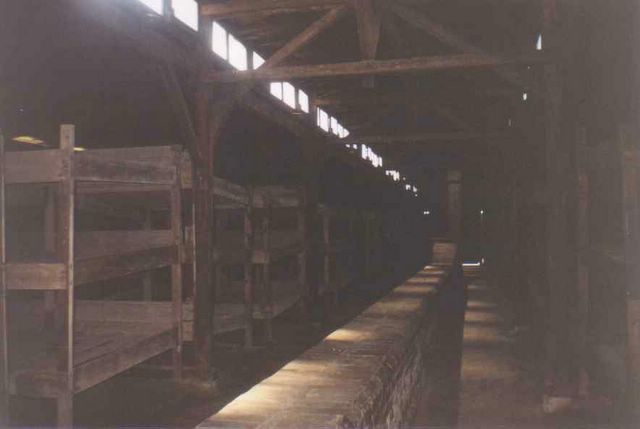
Midway through the day, a shuttle bus took our tour group to Birkenau. After the tidy brick two-story buildings and streets of Auschwitz, Birkenau is huge, and crude. There are rows and rows of brick and then wood barracks, most of these destroyed with just the brick chimneys left. The size of the enterprise is staggering. Of the prisoners arriving by train at Birkenau, after days in a closed cattle car with no food or water, only those who looked strong and capable of work were registered as prisoners. The rest were generally killed straight away. This means that the hundreds of barracks, where prisoners slept three to a single bed and six or seven to a double, only represent a tiny fraction of the total numbers of people coming into the camp.

Although the new bigger camp was crude and unfinished, the design was chillingly effective. Train tracks lead to a 'selection' area and then on to the 'showers' which, along with the crematoria, were underground. The guide told us that when the death camp was in operation, all that could be seen on the surface was grass and flowers and a little white building. People heading for the 'showers' would have been naïve not to expect that something was up, but I don't know how many would have imagined the truth.

When the newcomers arrived at their destination, officially known as Bunker No. 1, they saw two neat little farmhouses, with thatched roofs and whitewashed walls, surrounded by fruit trees and shrubbery.

Otto Friedrich (1994): The Kingdom of Auschwitz, p 31.

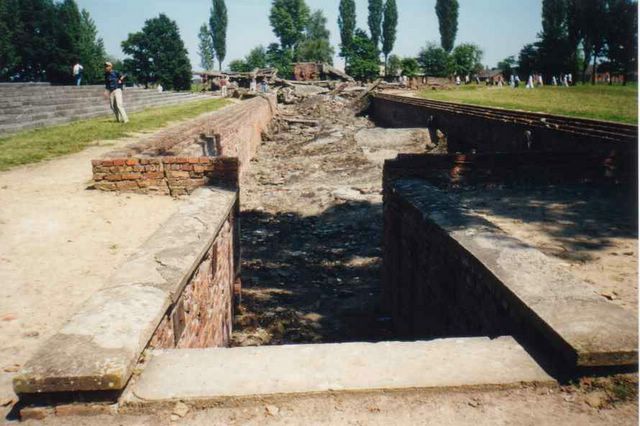
The gas chambers and crematoria at Birkenau, much bigger than the experimental ones at Auschwitz I, were destroyed by the Nazis as they retreated.


Barracks.


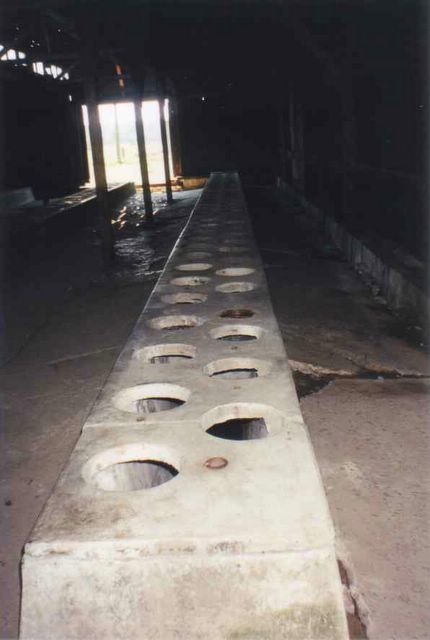
Toilets.


At the time I though it was an anticlimax to be there. It was very moving, but didn't quite hit home. Just a place. You need the information, and the imagination, and the fear and the horror, to make it real in your mind. Just a place, where some people did unthinkable things to other people. Being there and seeing the wood and the brick and wire of it actually mades it, paradoxically, a little harder to really believe.

At Auschwitz I stood in a room where hundreds of people were gassed, an early prototype for the purpose-built gas chambers at Birkenau. In an adjoining room we saw the remains of an oven where those bodies were cremated. But these are now just rooms in a museum. I've since realised that that ordinariness - just buildings and rooms - is important. It means that evil can be done anywhere. Thinking of the Nazis as devils or automatons following orders can lead you to miss the point that it was just people (with families and pets and all) who did these things. It's not really a careless choice of costume that we ought to be watching out for. It's a dozen less visible, and more isidious events that happen every day.

On the bus going back to Krakow I heard Bananarama. I think it was the same driver, though it was a more comfy bus.


Auschwitz Memorial and Museum

Yad Vashem, Jerusalem

about the Holocaust

Wednesday, June 08, 2005

pretty as.

I sent in the photo below to Riotact for their Images of Canberra series. There are some lovely photos, and a few funny ones. Worth a look.

Sunday, May 29, 2005

Red was the colour


 Posted by Hello
I took this about two weeks ago, in Yarralumla near the lake. Autumn trees, summer sky.

Saturday, May 28, 2005

Thursday, May 26, 2005

Happy Birthday Grandpa!

Though I guess this post is more for the rest of us. Grandpa would have been 88 today. What a fabulous age. I'm so sorry he died and wish he could have stuck around a bit longer.

Thursday, May 19, 2005

A visit to Auschwitz

Another story from my 2001 trip to Poland.

On 29 June 2001, I caught a bus headed for Oswiecim, from Krakow central train station early in the morning. It was a gorgeous sunny morning and the driver had the radio on. The song I remember is 'Karma Chameleon' by Culture Club.

It turned out to be a very hot, bright day, and I wished I had a hat because we did a lot of walking outside. The weather was kind of shocking, in contrast to the bleak pictures in my mind, of snow and mud.

There were actually several concentration camps in the vicinity of the town of Oswiecim. ('Auschwitz' is the German version of the Polish name.) Auschwitz I was converted from an abandoned Austrian artillery barracks. Later, the much larger Birkenau (Auschwitz II) was built nearby. We started at Auschwitz I, where we paid 20zl (about $10) each for entry to both camps and a tour. Although there were young children around, there was no entry charge for kids. I think the management recommends that kids under 14 don't go there at all, though of course this is the parents' decision and depends on the disposition of the kids in question. I think even hearing about the gas chambers and ovens, let alone seeing them, would probably have given me nightmares when I was a kid.

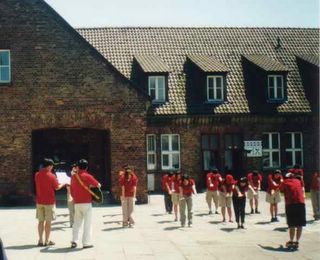
When we arrived this group were singing and dancing out the front. I had seen the same group in Warsaw's Old Town a week or so earlier. My best guess is they were a travelling Christian group, possibly evangelising or maybe just sharing the love. It was an odd note to strike outside Auschwitz.

 
The tour started with a 20-minute film, mainly consisting of footage of the Russian liberation of the camps. Appropriately, this was not an in-depth documentary, and it worked well to set the scene.

We were part of a group of about 20 people, which was too many. Several times we crossed the paths of other groups, which sometimes made it hard to hear our guide.

I usually have a hard time deciding whether to join tour groups or not. I like the unexpected bits of information you sometimes get, if the guide is really good and maybe has an unusual perspective. But I really like to take my time in museums, and often with a group you don't get enough time or space to take it all in. Both Auschwitz and the much larger camp at Birkenau have plenty of explanatory signs in English, and there is also a pamphlet available for sale, to help find your way around. It didn't take long for me to wish that I'd taken the self-tour option. There were lots of places I wanted to go back to for a closer look, and of course, we ran out of time.

I'm really glad that I took a few photos of parts of the camp with my old dodgey camera, because I had beem thinking of buying a book or some pictures in the shop before we left, and didn't get a chance to do that either.
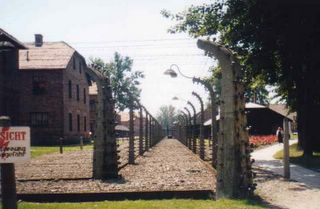

 
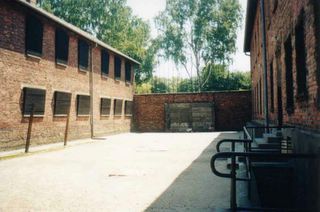
This is a firing wall where people were shot, mostly while the Nazis were still looking for more efficient methods of killing people.

 
One of the museums at Auschwitz had this plaque on the wall describing the “distinguishing marks”.
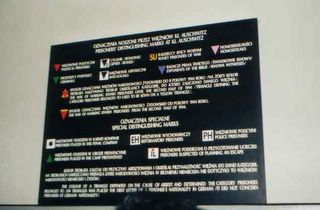

 
Their uniforms bore triangles of different colors, according to the categories of prisoners – green for professional criminals, red for political opposition, black for prostitutes and other “asocials”, pink for homosexuals, purple for fundamentalist “exponents of the Bible”. (Jews who fitted any of these categories had their yellow triangle superimposed on the other triangle to form a Star of David).

Otto Friedrich (1994): The Kingdom of Auschwitz, p 34

The tour at Auschwitz took us through several rooms set up with museum-style displays. There were others that we didn't get time for, and I had hoped to come back at the end of the day but that didn't happen. You may have seen pictures of displays like this one of a huge glass case piled with shoes. Another one had hundreds of suitcases. After the liberation, enormous stockpiles of personal belongings were found in the remains of 'Canada' – the nickname for the area of Birkenau where tonnes of valuables were stored before being sent back to Germany.

Because of the large numbers and jumbled state of the items, these simple exhibits provoke thoughts about the scale of the operation, the sheer numbers of people who came to Auschwitz and the other concentration and death camps. At the same time all those suitcases carefully labelled, all the different types and sizes of shoes, reflect the individuals involved, families who packed their possessions for the trip to who knew where, in a stinking cattle car. I imagine them trying to work out which things they'd need the most, and maybe which few easy-to-carry valuables to include for barter. Things to help you start a new life after being shipped out of your country because of your religion or culture. (I first wrote "kicked out" in that sentence, then I realised that wasn't the case; at least if you're kicked out you might be able to make some kind of choice what direction to go in.) Of course there was no such option of a "new life", or any life at all, even as refugees, for most of these people.

To be continued.
Friday, May 06, 2005

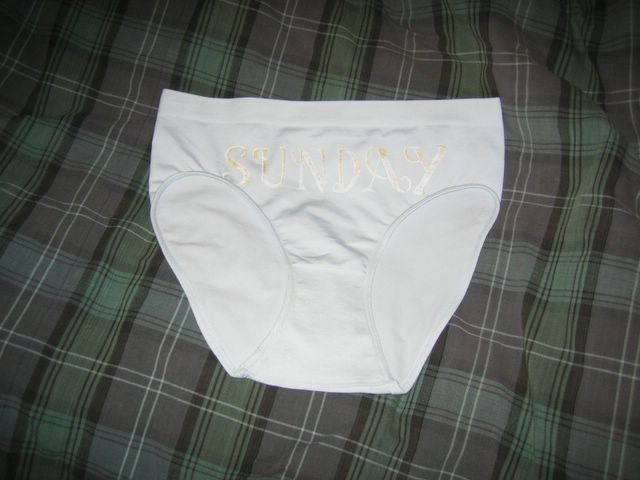
They don't make Sunday. Because of God.

Look what my amazing talented sister made me!


 Posted by Hello

I bet this chick would love a pair of these. (I swear I didn't even search for this site, I actually happened across it through a knitting blog.)


 Posted by Hello